How Interior Designers Use AI Staging to Win More Clients
There's a knee-jerk reaction a lot of interior designers have when they first hear about AI staging. It goes something like: "Great, another tool trying to replace me."
I get it. But that reaction is exactly backwards.
The designers who are actually using AI staging — not theorizing about it on Instagram, but billing clients with it — will tell you the same thing. It's not a replacement for design expertise. It's a lever that multiplies it. A designer with strong taste and an AI staging tool closes more projects, presents more convincingly, and earns more per client than one without it.
Let me show you how.
How are designers using AI staging in client consultations?
The hardest part of selling interior design services has always been the imagination gap. You can see the potential in a room. Your client cannot. You're talking about "opening up the sightlines" and "grounding the seating area with a textured rug" and your client is staring at their empty living room trying to picture it and failing.
Mood boards help. Renderings help more. But traditional 3D renderings take hours — sometimes days — and they're expensive to produce. Most designers can't afford to create detailed renderings for a consultation that might not convert to a paying project.
AI staging changes that math entirely.
Here's how Sarah, a residential designer in Austin, uses it. Before a consultation, she asks the potential client to send phone photos of the rooms they want designed. Nothing fancy — iPhone snapshots are fine. She uploads those to Stagrr and generates three different design directions per room. Takes about 20 minutes.
She walks into the consultation with printed before-and-after boards for every room. "Here's your living room now. Here are three directions we could take it." The client can see the potential immediately. No imagination required.
Sarah told me her close rate went from around 40% to over 70% after she started doing this. That's not a small improvement. That's a career-changing shift.
Does AI staging work for mood boards and concept development?
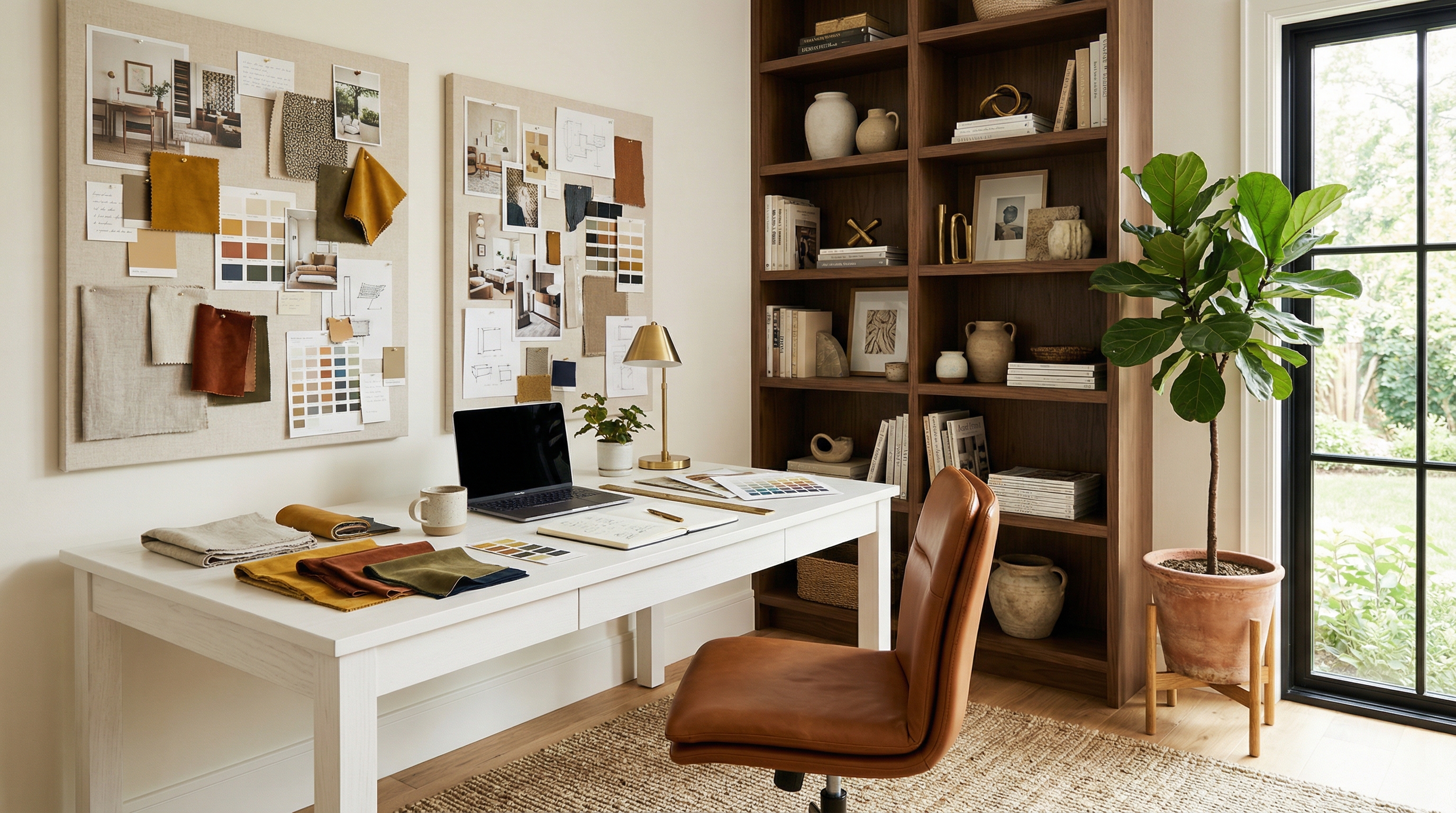
Traditional mood boards are collages — fabric swatches, furniture cutouts, paint chips, inspiration photos from other rooms. They're useful but abstract. The client has to mentally assemble all those pieces into a coherent picture of their own space.
AI-staged images of the client's actual room are concrete. This is what YOUR living room could look like in a coastal aesthetic. This is what YOUR bedroom could look like in warm contemporary. The specificity is what makes them powerful.
Several designers I've spoken with have started using a hybrid approach. They create a traditional mood board for the design concept — materials, colors, textures, references — and pair it with an AI-staged photo of the client's actual room in that style. The mood board communicates the feeling and the details. The staged photo communicates "this is real and it's happening in your space."
That combination is devastatingly effective in presentations.
For concept development specifically, AI staging is fast enough to use as a brainstorming tool. Not sure whether a room should go mid-century or Scandinavian? Generate both in five minutes and compare. It's like sketching, but the output is photorealistic. You can explore directions that would have taken half a day in SketchUp and evaluate them in seconds.
Can designers use AI staging to expand their portfolios?
Here's a use case that doesn't get talked about enough.
New designers have a chicken-and-egg problem. You need a portfolio to get clients. You need clients to build a portfolio. The traditional solution is to design friends' apartments for free or create speculative renderings. Both are slow.
AI staging offers a faster path. Photograph empty rooms — your apartment, model units, open houses — and stage them in your signature style. The result is a portfolio piece that shows your design sensibility applied to a real space. It's not the same as a completed project photo, and you should be transparent about that, but it demonstrates your eye and your taste in a way that a mood board alone cannot.
Established designers use this differently. If you specialize in coastal design but want to show potential clients you can also do modern farmhouse, generate some examples. If you're expanding into commercial spaces, stage a few office environments. It's portfolio R&D at negligible cost.
One designer in Miami told me she created an entire "design lookbook" — 30 rooms across six styles — in a single afternoon. She uses it at every initial consultation. "Here's the range of what I do." Clients flip through it and point to what resonates with them. It shortcuts the conversation about style preferences by 20 minutes.
How does AI staging create new revenue streams for designers?
This is where it gets interesting from a business perspective.
**Virtual staging as a standalone service.** Several designers have added virtual staging as a menu item — separate from full interior design services. A real estate agent needs a listing staged? $150–$300 per room for the designer's curated eye applied through AI staging. The designer selects the style, reviews the output, maybe requests a few variations, and delivers a polished result. The cost to produce it is minimal. The margin is enormous.
**"Design preview" packages.** Offer potential clients a paid first step before committing to a full design project. For $500–$1,000, you'll stage their top 3–4 rooms in two style directions each. They get beautiful images they can use immediately (for selling, renting, or just dreaming), and you get a paid foot in the door that often converts to a full project. It's a try-before-you-buy that benefits everyone.
**Rapid iteration for existing clients.** Mid-project, a client gets cold feet about the direction. Instead of spending days on revised renderings, generate a few alternative takes in 30 minutes. You've just saved a week of back-and-forth and kept the project on track. Some designers bill this as a change-order visualization fee. Others absorb it as a cost of faster project completion.
**Content creation.** Designers live and die by their Instagram and Pinterest presence. AI staging lets you produce a constant stream of before-and-after content without waiting for projects to complete. Stage a room on Monday, post it on Tuesday, get inquiries on Wednesday. The content pipeline never runs dry.
Won't clients think AI staging is "cheating"?
I hear this concern from designers regularly. The anxiety is that clients will perceive AI-generated visuals as less valuable than hand-crafted renderings.
Two things about this.
First, clients don't care about the tool. They care about the result. If the staged image accurately represents a design direction that excites them, the fact that it was generated by AI rather than hand-modeled in Blender is irrelevant. Nobody asks their architect what brand of pencil they used to sketch the floorplan.
Second, the value you're providing isn't the image — it's the design judgment behind it. Anyone can upload a photo and click "stage." The skill is in knowing that this particular room needs warm contemporary, not modern minimalist. That the scale of the existing windows calls for lower-profile furniture. That the northern exposure means warm-toned textiles will counterbalance the cool light. The AI generates the image. You make the decisions that determine whether the result is good.
That expertise is your moat, and AI staging actually makes it more visible, not less. When a client sees three design directions and one clearly resonates more than the others, they're experiencing your taste in action. That builds confidence in your abilities.
What about the quality concern?
Fair question. Two years ago, AI-staged images had obvious tells — furniture that floated slightly above the floor, inconsistent shadow directions, textures that looked painted on. Designers with trained eyes spotted these immediately and rightfully dismissed the technology.
That's not where we are anymore. Current AI staging produces results that are difficult to distinguish from professional interior photography in most cases. Not always perfect — complex architectural details and unusual room shapes can still trip up the models — but good enough for consultation purposes and marketing.
And here's the nuance: for the use cases we're talking about — consultations, mood boards, portfolio development, social content — photorealistic perfection isn't the bar. The bar is "does this effectively communicate the design concept?" If the client looks at the image and says "Yes, that's what I want," the image has done its job.
For final project renderings that represent a contracted design scope, most designers still use traditional 3D rendering tools. AI staging is a complement to those workflows, not a replacement.
How should designers price AI staging services?
If you're adding virtual staging as a service line, don't price it based on your cost. Price it based on the value to the client.
Your cost per room is about $1 plus 10–15 minutes of your time to select styles, review outputs, and curate the best results. Maybe $25–$40 in fully loaded time cost per room.
The value to a real estate agent? A faster sale, a higher sale price, and a listing presentation that wins clients. That's worth $150–$500 per room depending on your market and the property price point.
The value to a homeowner considering a renovation? A concrete visualization of what their $50,000 kitchen remodel could look like before they commit. That's worth several hundred dollars easily.
The value to a developer with 20 model units to market? Staged photos for every unit in multiple styles for a fraction of what a single model unit costs to physically stage. Price accordingly.
Don't leave money on the table by charging cost-plus. You're selling your design expertise with AI as the delivery mechanism. The expertise is the valuable part.
What's the bottom line for designers?
The designers who will thrive in the next few years are the ones who embrace AI as a tool in their kit — alongside fabric samples, CAD software, and their relationships with vendors. It doesn't diminish what you do. It amplifies it.
You went to school for this. You've spent years developing your eye. You understand proportion, balance, color theory, and how people actually live in spaces. That knowledge doesn't become less valuable because the rendering tool got faster and cheaper. It becomes more valuable, because now you can deploy it at scale.
The interior design market in the US is projected to hit $36 billion by 2027, according to IBISWorld. There's plenty of room. The question isn't whether AI will be part of the industry — it already is. The question is whether you'll use it to grow your practice or watch competitors use it to grow theirs.