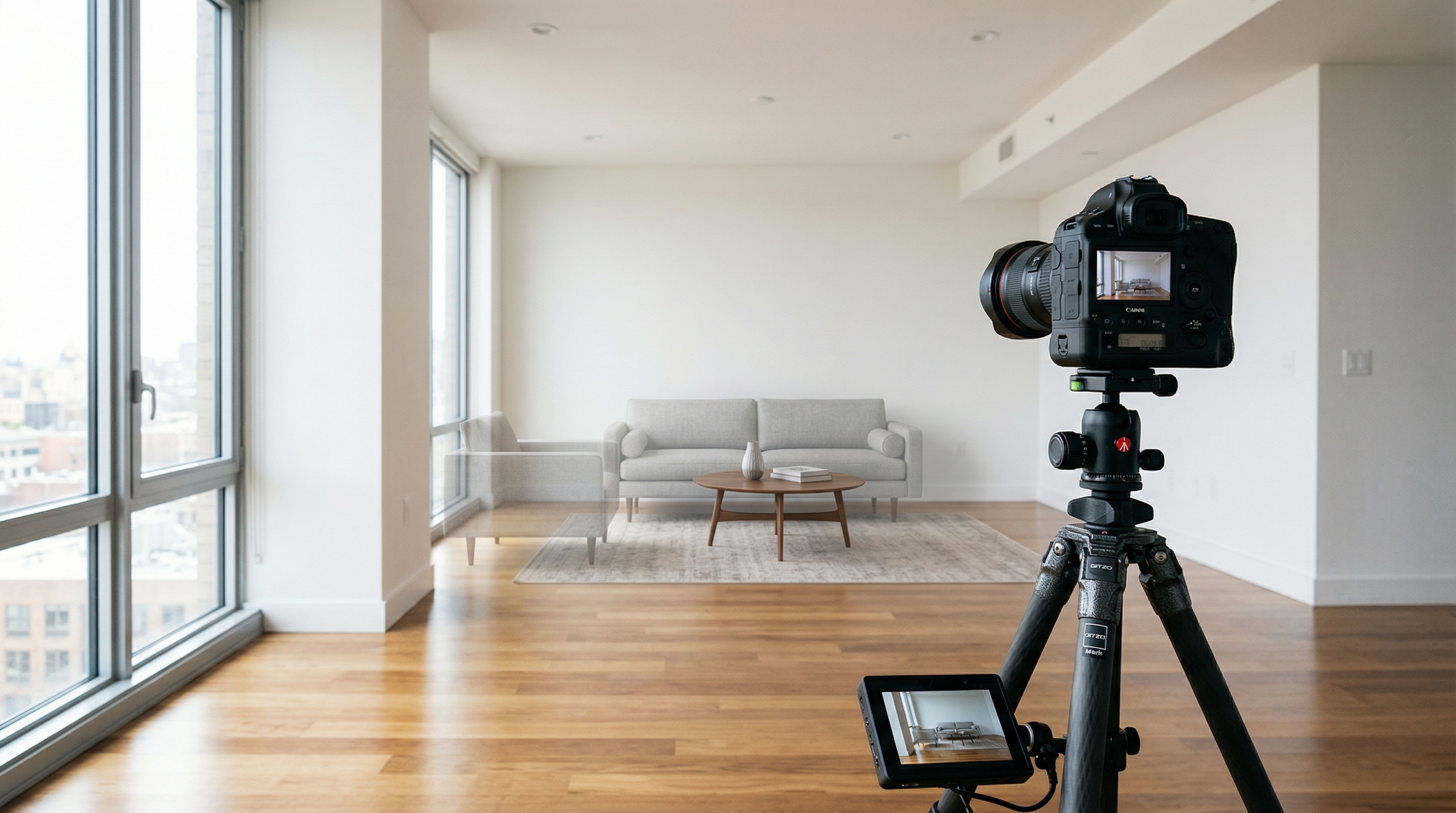
The Real Estate Photographer's Guide to AI Staging
I shot real estate for six years before I added virtual staging to my service menu. I wish I'd done it from day one. Not because the technology existed back then — it didn't, at least not at a quality level worth offering — but because the economics are so absurdly good that it changed my entire business model.
If you're a real estate photographer doing 8-15 listings a week and you're not offering AI staging as an upsell, you're leaving $2,000-6,000 on the table every single month. That's not a hypothetical. That's basic multiplication, and I'll walk through the math below.
Why should photographers care about virtual staging?
Agents already trust you with their visual marketing. You're the person they call when a listing needs to look good. Staging is a natural extension of that relationship — you're not selling something foreign, you're deepening a service you already provide.
The old virtual staging workflow was painful. You'd shoot the property, edit the photos, send select images to a virtual staging company in the Philippines or Eastern Europe, wait 24-48 hours, review the results, request revisions, wait again, and finally deliver to the agent. The whole cycle added days to your turnaround and required project management overhead that ate into the margin.
AI staging compressed that entire process into minutes. You upload the photo, pick a style, and the staged version comes back before you've finished culling the rest of the shoot. At Stagrr, you get three variations per room for a dollar. Your input cost per listing is somewhere between $3 and $8 depending on how many rooms the agent wants staged.
What does the pricing math actually look like?
Here's where it gets fun. Let's say you charge $75 per staged image as your upsell price. That's on the conservative side — many photographers charge $100-150 per image, especially in markets like Dallas, Chicago, or the Bay Area where listing budgets are higher.
A typical staging package covers 4-6 rooms: living room, primary bedroom, kitchen, dining room, maybe a home office or second bedroom. Call it 5 rooms at $75 each. That's $375 per listing.
Your cost? Five bucks on Stagrr. Maybe ten if you run a couple extra rooms or regenerate a few images. Your margin is over 95%.
Now scale it. At 10 listings per week with a 60% upsell conversion rate (which is realistic once agents see the quality), that's 6 staged listings. Six times $375 is $2,250 per week. Over $9,000 a month in added revenue with maybe $200 in platform costs.
Even at a lower price point — say $50 per image — the numbers still work beautifully. Five rooms at $50 is $250 per listing. Six listings a week puts you at $1,500 weekly, or $6,000 monthly. Your costs stay the same.
A photographer I know in Phoenix prices it differently. She bundles staging into her premium package: $450 for photos plus staging of up to 6 rooms, compared to $275 for photos only. Her premium package adoption rate is 72% because agents see the value immediately when she shows before-and-after samples on her iPad during the walkthrough.
How does AI staging fit into an existing editing workflow?
This is the part that matters operationally. Your editing pipeline probably looks something like this: import, cull, edit in Lightroom, export, deliver via a gallery or download link. Staging slots in right after your Lightroom export.
Batch your staging work. After you export your finals from Lightroom, pull the rooms that need staging and upload them to Stagrr in one session. While those process (we're talking 30-60 seconds per room), you can continue organizing the rest of the gallery. Download the staged versions, drop them into the delivery folder alongside the original empty shots, and you're done.
Total time added to your workflow: 10-15 minutes per listing. That's it.
Some photographers I've talked to prefer to stage on-site while the agent is still at the property. They shoot the empty rooms, upload from their phone or laptop in the car, and show the agent staged previews before they've even left the driveway. That immediate wow factor is what closes the upsell — agents get to see their listing transformed while they're still standing in it.
One workflow consideration: always deliver both the original empty room photo and the staged version. Agents need the originals for MLS compliance in many markets, and having both gives them flexibility. Label your files clearly. I use a simple convention: "living-room-01.jpg" for the original and "living-room-01-staged-warm-contemporary.jpg" for the staged version. Tedious? Slightly. But it prevents confusion and makes you look professional.
How do you manage client expectations around quality?
This is real talk. AI staging is excellent, but it's not perfect 100% of the time. Maybe one in fifteen images will have a minor artifact — a table leg that clips through a shadow, a rug edge that doesn't quite align with the floor plane. Most viewers won't notice, but you will because you're a photographer and you pixel-peep everything.
Set expectations early. When you pitch staging to an agent, show them 4-5 of your best examples. Don't show them raw output — show them your curated best. Explain that you review every staged image before delivery and only send the ones that meet your quality standard. This positions you as a quality filter, not just a middleman.
If a particular room generates three variations and none of them are great? Run it again. The cost is another dollar. Or try a different style. Sometimes a room that looks awkward in Modern Minimalist looks stunning in Warm Contemporary because the furniture better fits the proportions.
Build a portfolio of your staged work. Create a before-and-after gallery on your website. Post comparisons on Instagram. Agents in the Real Estate Photography Facebook groups eat this content up. The best marketing for your staging upsell is proof that it looks good — and it does.
How does AI staging compare to traditional virtual staging services?
Traditional virtual staging services — the ones with human designers placing 3D-rendered furniture — charge $75-200 per image and take 24-48 hours. Some premium services charge $300+ for rush delivery. The quality is generally high because a human is making design decisions, but the turnaround and cost make them a harder sell.
AI staging costs $1 for three variations, delivers in under a minute, and the quality gap has narrowed to the point where most agents can't tell the difference. In a blind test I ran with 14 agents in my market last fall, only 3 could consistently identify which images were AI-staged versus traditionally virtually staged. None of the agents who couldn't tell the difference cared once I told them.
The speed advantage compounds. If an agent calls you at 2 PM asking for staged photos by 5 PM for a broker open tomorrow morning, you can deliver. Try that with a traditional staging service.
There's still a place for traditional virtual staging on ultra-luxury listings where every pixel matters and the marketing budget supports the cost. For the other 95% of listings, AI staging wins on speed, cost, and practicality. We break down the full comparison in our post on virtual staging versus traditional staging.
What should you actually charge?
Price your staging based on your market, not on your costs. Your cost is essentially zero — a few dollars in platform fees. Your price should reflect the value to the agent.
In most markets, $50-100 per staged image is the sweet spot. Some pricing structures that work well:
Per-image pricing at $75-100 works for agents who only want 2-3 rooms staged. Simple, easy to understand.
Package pricing works better for full-listing staging. Something like $350 for up to 6 rooms staged in your choice of style. That feels like a deal compared to per-image pricing and encourages agents to stage more rooms.
Bundle pricing — rolling staging into your photography package at a premium — gets the highest adoption rate. Instead of pitching staging as a separate line item, you offer a "Standard" package (photos only) and a "Premium" package (photos plus staging). The price difference should be $150-200. Agents who are already spending $300+ on photography rarely balk at another $175 for staging.
Don't undersell it. I've seen photographers offer staging at $20 per image because they feel guilty about the margin. That's backwards. You're not selling a dollar's worth of AI processing — you're selling your expertise in choosing the right style, your quality control, your integration into a seamless delivery pipeline, and the convenience of getting everything from one vendor. That's worth real money.
What about volume and scaling?
Here's something photographers don't think about enough: staging scales without adding labor in the way that photography doesn't. You can only physically shoot so many properties in a day. But staging is digital. You can stage 50 listings in the time it takes to shoot 5.
Some photographers have leaned into this by offering staging as a standalone service to agents they don't shoot for. An agent has photos from another photographer or even just phone photos? You'll stage them for $75 a room. No shoot required. That's pure margin work you can do from your couch at 9 PM.
One photographer in Austin told me he makes more from staging-only clients than from his photography clients. He charges $100 per image, does zero shooting for those clients, and processes 30-40 images a week in about two hours total. That's roughly $3,000-4,000 a week for two hours of work.
The bottom line: AI staging is the most profitable service addition available to real estate photographers right now. The costs are negligible, the workflow integration is minimal, the demand is already there, and the margins are extraordinary. Every week you wait to add it is money walking out the door.