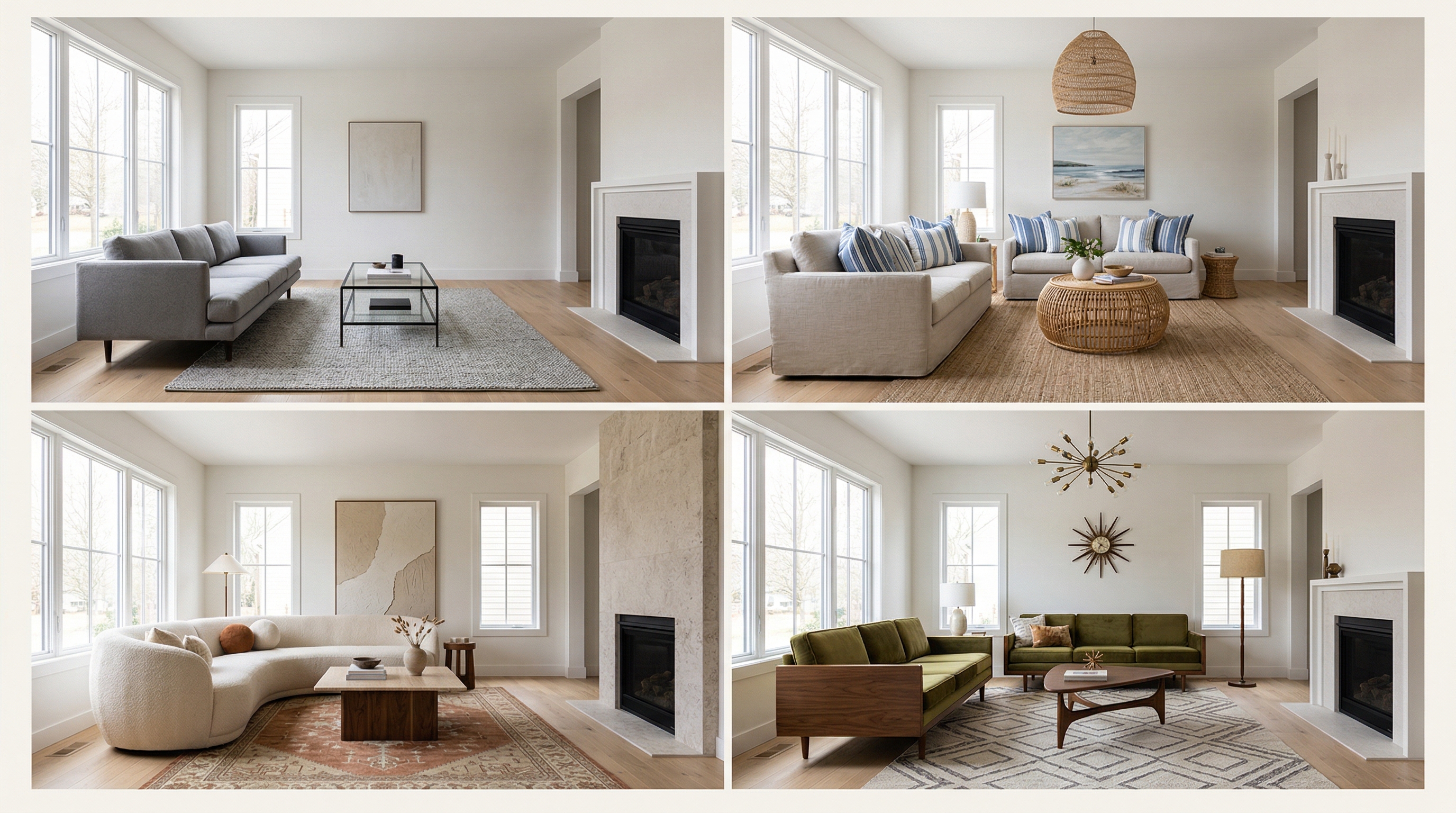
The 8 Staging Styles That Sell Homes Fastest (And When to Use Each)
Choosing the right staging style isn't just about what looks pretty — it directly impacts how quickly a property sells and at what price. A 2024 analysis by the Real Estate Staging Association found that properties staged in a style matching the target buyer demographic sold 18% faster than those staged in a generic or mismatched style.
The wrong style can actually hurt you. A luxury modern staging in a $180K starter home feels aspirational in the wrong way — it makes buyers feel like they can't afford to live there. A rustic farmhouse look in a downtown high-rise condo confuses everyone. Style matching is a strategic decision, not a decorating preference.
Here are the eight styles that consistently perform best in real estate staging, what makes each one work, and — more importantly — when each one will backfire.
Which staging style has the broadest appeal?
Warm Contemporary is the safest default and the most universally appealing style across demographics. Plush, oversized sofas in cream and taupe. Rounded furniture shapes with soft edges. Textured fabrics like boucle, velvet, and chunky knit throws. Warm wood tones — think walnut and oak, not mahogany. Organic ceramic vases and understated sculptural decor.
The psychology here is simple: this style reads as "expensive and inviting" without being polarizing. A 30-year-old couple and a 55-year-old empty-nester both look at a Warm Contemporary room and think "I could live here." That's rare. Most styles skew toward a specific age or taste profile. Warm Contemporary threads the needle.
Use this for: Suburban homes, move-up buyers, family properties, and any listing where you genuinely don't know who your buyer is. It's also the strongest performer in the $300K–$700K range — the heart of the market where buyer demographics are broadest.
Avoid this for: Urban studios and lofts where the oversized furniture overwhelms the space, or ultra-modern new construction where it can feel too soft and traditional against sharp architectural lines.
What staging style works best for small spaces and condos?
Modern Minimalist. Clean lines, neutral tones, deliberately sparse furniture arrangement. Think a slim-profile sofa in light gray, a single accent chair, a coffee table with clean geometry, and very little else. The negative space is the point — it makes rooms feel substantially larger than they are.
This style photographs exceptionally well because there's visual breathing room in every shot. The eye isn't competing with 15 objects. On Zillow or Redfin thumbnails — where buyers make snap decisions in under two seconds — that clarity translates directly to more clicks.
A 750-square-foot one-bedroom staged in Modern Minimalist looks like a 900-square-foot one-bedroom. The same unit staged in Warm Contemporary, with its oversized furniture, looks like a 600-square-foot one-bedroom. That perception gap matters enormously when buyers are filtering by square footage.
Use this for: Urban condos, lofts, studios, and any space under 1,200 square feet. Young professional buyers respond especially well — the 25–35 demographic rates this as their top preference in multiple surveys.
Avoid this for: Large suburban homes where it reads as cold and under-furnished. A 3,000-square-foot family home with one slim sofa in each room looks like nobody can afford to finish decorating.
When should you use Coastal staging?
Coastal works year-round in beach and waterfront markets and seasonally (April–September) everywhere else. Whites, soft blues, natural rattan furniture, jute rugs, linen upholstery, driftwood-toned accessories. It's aspirational without being intimidating — buyers see it and think vacation, relaxation, escape.
The key to making Coastal staging work is natural light. This style needs windows. A sun-drenched living room with ocean views and Coastal furniture is a dream listing. A basement apartment with no windows and Coastal furniture looks like a sad beach house rental. Light is the non-negotiable prerequisite.
In the right context, Coastal staging creates powerful emotional responses. It's one of the few styles where buyers describe their reaction in feelings rather than features: "I felt relaxed looking at those photos" versus "I liked the furniture." That emotional pull translates to higher engagement and, often, faster offers.
Use this for: Beach communities, waterfront properties, lake houses, warm-climate markets (Florida, Southern California, Hawaii, the Carolinas), and spring/summer listings in any market.
Avoid this for: Dark interior rooms, urban high-rises, and properties in markets where the beach association feels forced or irrelevant (think downtown Chicago in January).
Which style is the ultimate crowd-pleaser for uncertain markets?
Transitional. If Warm Contemporary is the safe choice, Transitional is the even safer choice. It's a deliberate blend of traditional and contemporary — classic furniture silhouettes with modern clean lines. Neutral palette with warm undertones. Everything about this style is calibrated to offend absolutely nobody.
Think of it as the design equivalent of a candidate who polls well with every demographic. A tufted sofa with clean lines (traditional shape, modern execution). Wood furniture in medium tones (not too light, not too dark). Coordinated but not matchy-matchy accessories. The overall effect is "tasteful home" with no further adjectives required.
Transitional staging performs especially well in markets with diverse buyer pools — areas where the next owner could equally be a young family, a retired couple, or a professional relocating from another city. It's also the best choice for estate sales where the property itself might feel dated; Transitional staging modernizes the perception without jarring against older architectural details.
Use this for: Any property where broad appeal trumps design impact. Estate sales, mixed-demographic neighborhoods, relocation corridors, and listings where you've had zero showing feedback after two weeks (restyle to Transitional and watch what happens).
Does Mid-Century Modern staging actually sell homes faster?
In the right context, yes — and the effect is stronger than almost any other style. Mid-Century Modern has undergone a massive cultural resurgence. Tapered furniture legs, organic curves, warm walnut tones, and bold accent colors (mustard yellow, olive green, burnt orange) create strong emotional reactions in buyers aged 28–45. This demographic rates MCM as their most-desired interior style by a 2:1 margin over any other aesthetic, according to a 2024 Houzz survey.
The reason is partly architectural. Properties built in the 1950s–1970s — split-levels, A-frames, ranches, and post-and-beam designs — were designed for this furniture. When the architecture and the staging align, the listing feels curated rather than decorated. That coherence triggers a specific buyer response: "This house was made for me."
MCM staging also photographs beautifully. The bold accent colors pop against neutral walls, the sculptural furniture shapes create visual interest, and the warm wood tones add depth without visual clutter. On listing platforms, MCM-staged photos generate higher save rates and share rates than almost any other style.
Use this for: Mid-century architecture (obviously), urban markets with design-conscious buyers, properties targeting the 28–45 demographic, and any listing where you want to create a strong emotional response rather than broad neutrality.
Avoid this for: Traditional colonial or Victorian architecture where the style clash is jarring. Also skip it for rural properties or markets where the buyer pool skews conservative.
How effective is Modern Farmhouse for staging in 2026?
Still very effective, but with a caveat: saturation. Modern Farmhouse has been the dominant home decor aesthetic in American media for the better part of a decade. Slipcovered sofas, reclaimed wood, shiplap accents, black metal hardware, and Mason jar accessories reached cultural ubiquity through home renovation shows and Instagram.
The upside of this saturation is instant recognition. Buyers see Modern Farmhouse staging and immediately feel comfortable — it looks like the aspirational version of home they've been absorbing through media for years. It's comfortable, approachable, and photographs well in virtually any lighting condition.
The downside is that it can feel generic. In markets where every listing uses farmhouse staging, yours won't stand out. The differentiation value has eroded even as the appeal remains high.
Use this for: Rural and suburban properties, family homes, properties with architectural character (exposed beams, older bones, properties with land), and any listing in a market where HGTV-style aesthetics are still the dominant taste.
Avoid this for: Ultra-modern new construction, urban high-rises, and luxury properties where it reads as too casual.
What's the best staging style for first-time buyers and rentals?
Scandinavian. Light wood (birch, pine, ash), soft textiles, functional furniture, and a hygge atmosphere that makes any space feel warm and livable. This style requires less furniture than any other aesthetic — a bed, a side table, a reading lamp, and a knit throw can stage an entire bedroom convincingly.
That economy of elements is exactly why it works for rental listings and starter homes. Scandinavian staging says "this space is ready to live in" rather than "this space is a showpiece." For first-time buyers who are intimidated by the idea of furnishing an entire home, seeing a Scandinavian-staged room communicates "you don't need much to make this feel like home." That's a powerful psychological message.
Scandinavian also performs well in northern markets where buyers are accustomed to the aesthetic from cultural exposure and where the light wood tones complement the cooler natural light.
Use this for: Smaller spaces, first-time buyer price points, rental listings, and properties in northern or Pacific Northwest markets. Also excellent for Airbnb and short-term rental staging.
When should you use Luxury Modern staging?
Only when the property earns it. Luxury Modern means designer furniture (think B&B Italia, not West Elm), marble surfaces, brass and gold-toned metal details, statement lighting fixtures, and jewel-toned accents. This style signals wealth and taste, and it needs to be paired with architecture that backs up that signal.
A Luxury Modern staging in a $350K suburban colonial creates cognitive dissonance — the furniture suggests a $2 million penthouse while the house itself suggests something more modest. Buyers feel confused rather than inspired, and confusion kills offers. For more on the high-end approach, see our guide to luxury virtual staging.
But in the right property — new construction with floor-to-ceiling windows, penthouse condos, waterfront estates, architecturally significant homes — Luxury Modern staging elevates the listing from "expensive house" to "aspirational lifestyle." The furniture becomes a promise of what living there feels like.
Use this for: Properties above the 75th percentile price point in your market. New luxury construction. Penthouse and high-floor units. Architecturally notable homes.
Avoid this for: Everything else. This is the one style where misapplication actively hurts you.
How can you use multiple staging styles on a single listing?
This is where virtual staging creates a competitive advantage that traditional staging physically cannot match. With physical staging, you pick one style, pay thousands for the furniture, and hope it resonates with your buyer. If it doesn't, tough luck.
With virtual staging, you can generate the same room in three, four, or even all eight styles — and include multiple versions in the listing. A single living room staged in Warm Contemporary, Coastal, and Modern Minimalist gives three different buyer personas a reason to engage with the listing. The young professional sees the Minimalist version and pictures their first home. The relocating family sees the Warm Contemporary version and imagines movie nights. The vacation buyer sees the Coastal version and starts thinking about weekends.
The multi-style approach is especially powerful in markets with diverse buyer pools. Instead of guessing who your buyer is, you present options and let them self-select. At $1 for three images per room per style, the cost of showing four different versions of a living room is $4. Traditional staging would require $8,000–$20,000 and three separate furniture deliveries for the same effect.
The agents and property managers generating the strongest results right now aren't picking one style — they're running two or three and including the best images from each in the listing carousel. It takes ten minutes, costs less than a coffee, and reaches three times the audience.