Luxury Virtual Staging: High-End Results Without the High-End Price Tag
A vacant $4.2 million listing in the Hamptons sat on the market for 93 days before the agent pulled it, staged it traditionally for $38,000, relisted it, and had an accepted offer within three weeks. That story is so common in luxury real estate that it barely qualifies as a story. Everyone knows staging matters at the high end. The question has always been whether the cost and logistics are worth it.
At $15,000-50,000 for a single property, traditional luxury staging is a serious financial commitment. That range covers the furniture rental (designer-quality pieces aren't cheap to borrow), delivery and setup for what's often a 4,000-8,000 square foot home, the stager's design fee, and monthly rental extensions if the home doesn't sell fast. On a $5 million listing where the commission is $125,000-150,000, spending $40,000 on staging represents a meaningful chunk of the agent's cut.
AI virtual staging doesn't replace the experience of walking through a beautifully furnished luxury home. Nothing does. But it solves a different set of problems that luxury agents deal with constantly, and it does so at a cost that rounds to zero.
Why are luxury buyers harder to stage for?
Luxury buyers are a different animal. A buyer shopping for a $350,000 starter home sees staging and thinks, "That's nice, I could live here." A buyer shopping for a $3.5 million estate sees staging and evaluates it. They notice the brand of the sofa. They have opinions about the stone on the coffee table. They know what Restoration Hardware looks like versus Minotti versus B&B Italia, and they form judgments accordingly.
This means the margin for error is smaller. Cookie-cutter staging that works fine in the mid-market reads as cheap in a luxury listing. The furniture needs to look expensive because the buyer expects expensive. The design needs to feel intentional, curated, like an interior designer with a $200,000 budget made deliberate choices.
Traditional stagers who specialize in luxury understand this. They source from high-end rental houses, they select statement pieces, and they know how to dress a room so it photographs like the cover of Architectural Digest. That expertise is what you're paying for when you write that $30,000-40,000 check.
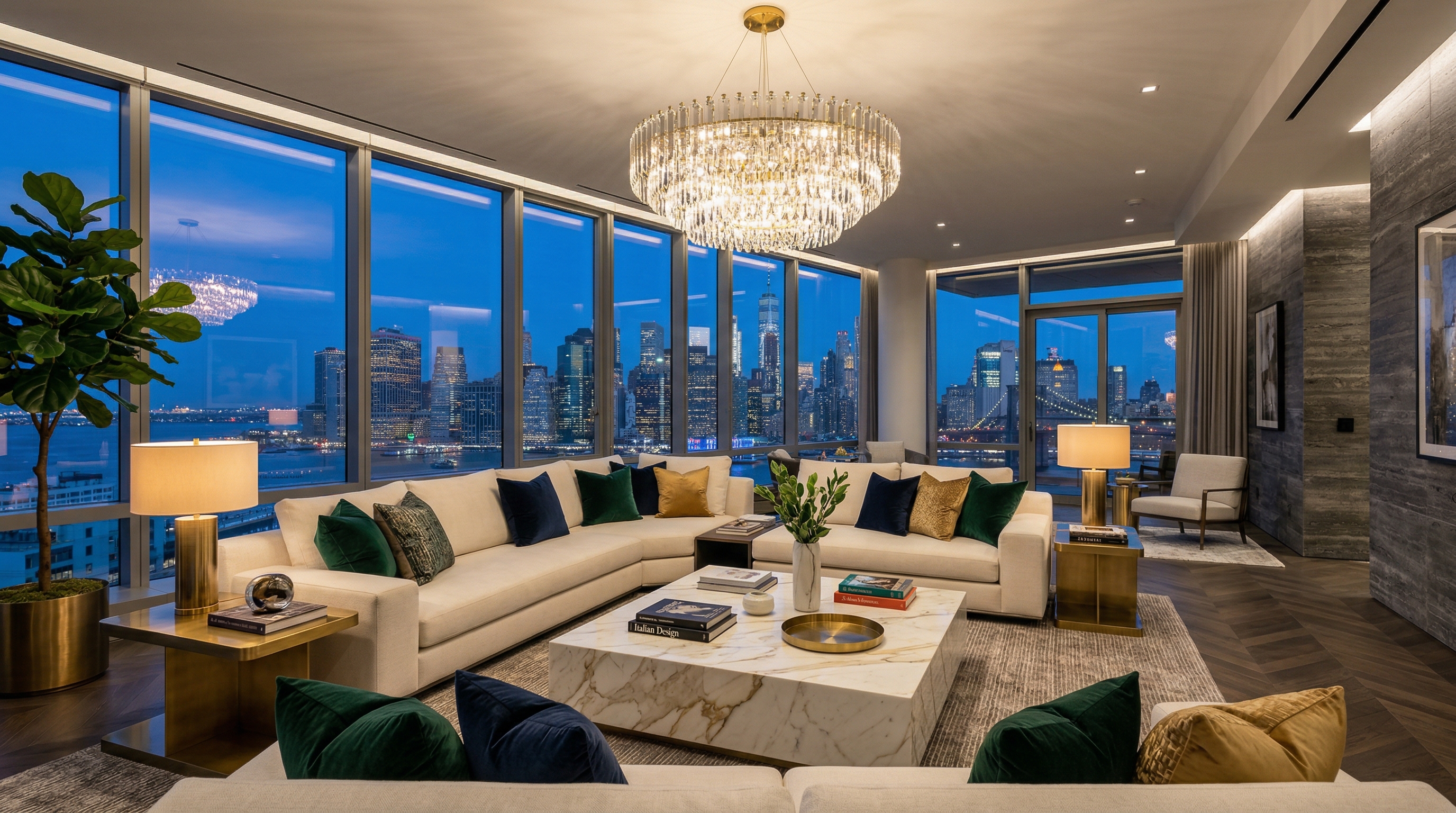
The interesting development in AI staging is that the models have gotten remarkably good at high-end aesthetics. They understand marble. They render brass and gold hardware convincingly. They place statement lighting fixtures — those oversized chandeliers and sculptural pendants that anchor luxury rooms — with appropriate scale and positioning. They know what a $15,000 sectional looks like versus a $1,500 one, because they've been trained on millions of interior photographs that include both.
How does AI handle high-end design details?
The specifics matter here, so let me be concrete.
Marble and stone. AI staging renders Calacatta marble, Nero Marquina, Carrara — the stones that show up in luxury kitchens and bathrooms — with realistic veining and color variation. Early virtual staging tools treated marble as a flat white surface. Current models understand that marble has depth, translucency, and pattern irregularity. The staged images show marble that looks like actual stone, not a printed laminate.
Metals. Brass, brushed gold, matte black, polished nickel. Luxury design leans heavily on metal finishes, especially in hardware, lighting, and accent furniture. The AI handles reflections and surface texture on metal convincingly. A brass-legged console table in a staged image catches light the way real brass does — not uniformly, not perfectly, but with the soft warmth that makes brass look like brass.
Statement lighting. Oversized fixtures are a hallmark of luxury staging. A Lindsey Adelman chandelier or a Flos sculptural pendant can define a room. AI models generate lighting fixtures that read as designer pieces — complex geometric forms, interesting materials, appropriate scale. They're not reproducing specific designer pieces (that would be a trademark issue), but they generate fixtures that feel like they belong in the same conversation.
Textiles and upholstery. Velvet, boucle, performance linen, cashmere throws. Luxury staging requires furniture that looks and feels premium, and that comes through in fabric texture. The AI renders these materials with appropriate visual weight — velvet has depth and sheen, linen has a relaxed drape, leather shows subtle grain.
What is the multi-style advantage for luxury listings?
This is where virtual staging creates something traditional staging literally cannot match, at any price.
A $6 million home in Beverly Hills might attract a tech founder who wants sleek contemporary, a Saudi investor who prefers ornate traditional, a young entertainment executive who loves mid-century modern, and a retired CEO who wants transitional warmth. Traditional staging picks one style and hopes it resonates with whoever walks through the door.
With AI staging, you show them all.
Generate the living room in four styles: Luxury Modern with Italian furniture and marble accents, Warm Contemporary with rich textiles and layered neutrals, Mid-Century Modern with walnut and statement color, and Transitional with classic silhouettes updated for 2026. Include all four in the listing gallery. Each buyer persona sees the version that speaks to them.
At Stagrr, staging one room costs a dollar and gives you three variations. Stage it again in a different style for another dollar. Four styles of one room costs $2 — you'll get 6 staged variations total and pick the best from each style. Traditional staging would need to furnish the room four separate times to achieve this. Nobody does that. The cost would be absurd.
I talked with an agent in Miami Beach who stages her luxury listings in three styles as standard practice. She told me her listings get 40-50% more saves on Zillow than comparable unstaged luxury listings in her market. "Buyers send me the styled version they like and say, 'I want this one,'" she said. "It starts a conversation about their taste before we've even scheduled a showing."
How should you approach staging vacant new construction?
New construction is the fastest-growing segment for luxury virtual staging, and it makes perfect sense when you think about it.
Developers and builders sell homes before they're finished all the time, especially in markets like Miami, Scottsdale, and the Bay Area where pre-sale is the norm. The challenge is marketing a property that's either a construction site or a freshly finished shell — beautiful bones, but no soul. Vast empty rooms with pristine white walls and gleaming hardwood floors that photograph as expensive emptiness.
Traditional staging for new construction developments gets complicated fast. A builder with 8 units needs to stage at least 2-3 model units. At $20,000-40,000 each, that's $60,000-120,000 in staging costs before a single unit sells. The furniture sits there for months, sometimes years, racking up rental fees.
Virtual staging lets you stage every unit individually, in styles that match each unit's unique features. The penthouse with the wraparound terrace gets staged in Luxury Modern to emphasize the indoor-outdoor flow. The garden-level unit with the courtyard gets Warm Contemporary to feel inviting. The unit with the chef's kitchen gets lifestyle staging with a dinner party setup on the dining table.
One developer in Coconut Grove told me they switched from traditional staging to virtual staging across a 12-unit boutique condo project and saved over $200,000. Their sales timeline didn't change — they still sold out within the projected timeframe — but the cost savings went straight to the bottom line. "The buyers couldn't care less whether the furniture in the photos was real," he said. "They were buying a $2.8 million condo. They were going to furnish it themselves anyway."
How do you position virtual staging for luxury clients?
Some luxury agents worry that virtual staging reads as cheap — that their high-end clients will view it as a cost-cutting measure. This concern is understandable but increasingly outdated.
The framing matters. You're not saying, "I saved money by not staging your home." You're saying, "I'm using AI to show your property in multiple design visions that appeal to different luxury buyers. Here's your home in contemporary Italian, here it is in warm transitional, here it is in California modern. Traditional staging picks one look. We're showing four."
That's not a downgrade. That's a strategic advantage.
For the actual in-person showing experience, luxury agents still need to consider how the home presents. Some use light staging — a few key furniture pieces in the main living areas — combined with virtual staging for the full photo gallery. The light staging handles the physical walkthrough, and the virtual staging handles the online marketing. This hybrid approach costs a fraction of full traditional staging while covering both bases.
Others skip physical staging entirely for vacant properties and rely on the virtual staging to drive showing requests, knowing that luxury buyers visiting a $5 million property understand they're looking at architecture, finishes, and potential — not evaluating furniture.
What about specific luxury markets?
Different luxury markets have different staging expectations and norms.
The Hamptons. Seasonal market, which means staging furniture sits unused for months during the off-season. Virtual staging eliminates this problem entirely. Dominant styles are Coastal Luxury and Transitional. Buyers here are sophisticated New Yorkers who respond to curated, editorial-quality imagery.
Beverly Hills and Bel Air. The most visually competitive luxury market in the country. Every listing has professional photography, drone footage, and cinematic video tours. Virtual staging needs to be flawless here because the competition is relentless. Luxury Modern and Contemporary dominate, with a growing appetite for organic modern — warm tones, natural materials, less glass-and-chrome sterility.
Miami and Miami Beach. New construction condo market is enormous, and developers are the primary buyers of virtual staging services. Art Deco influenced interiors compete with Ultra-Modern for attention. The international buyer pool means staging needs to appeal across cultures, which is another argument for the multi-style approach.
Aspen and mountain luxury markets. Rustic Luxury is its own category here — reclaimed timber, stone, fur throws, statement fireplaces. AI staging handles this aesthetic well because the style is so visually distinctive that the model has plenty of training data to work with.
The cost comparison in cold numbers
Traditional luxury staging for a 5,000 sq ft home: $20,000-40,000. Timeline: 1-2 weeks to coordinate, furniture stays for 3-6 months.
AI virtual staging for the same home (8 rooms, 3 styles each): under $10. Timeline: an afternoon.
That's not a marginal improvement. That's a category shift. And it means staging is no longer a decision that requires weighing costs against benefits for luxury listings. The cost is essentially zero, so the only question is whether you want better marketing photos or worse ones.
For more on how the technology behind AI staging works, see our post on how AI home staging actually works.