Why Vacant Homes Sit on the Market (And How to Fix It for $1)
Vacant homes have a problem, and it's costing sellers real money. They look smaller in photos, feel colder during showings, and give buyers nothing to anchor their imagination to. The data is consistent across every study that's looked at it — vacant properties sit on the market 30–50% longer than staged ones, according to multiple National Association of Realtors surveys conducted between 2020 and 2025.
That extra time isn't just an inconvenience. It's thousands of dollars in carrying costs, a growing stigma in buyer perception ("why hasn't this sold?"), and increasingly aggressive price reduction conversations with frustrated sellers. And the fix is absurdly cheap.
Why do empty rooms photograph so poorly?
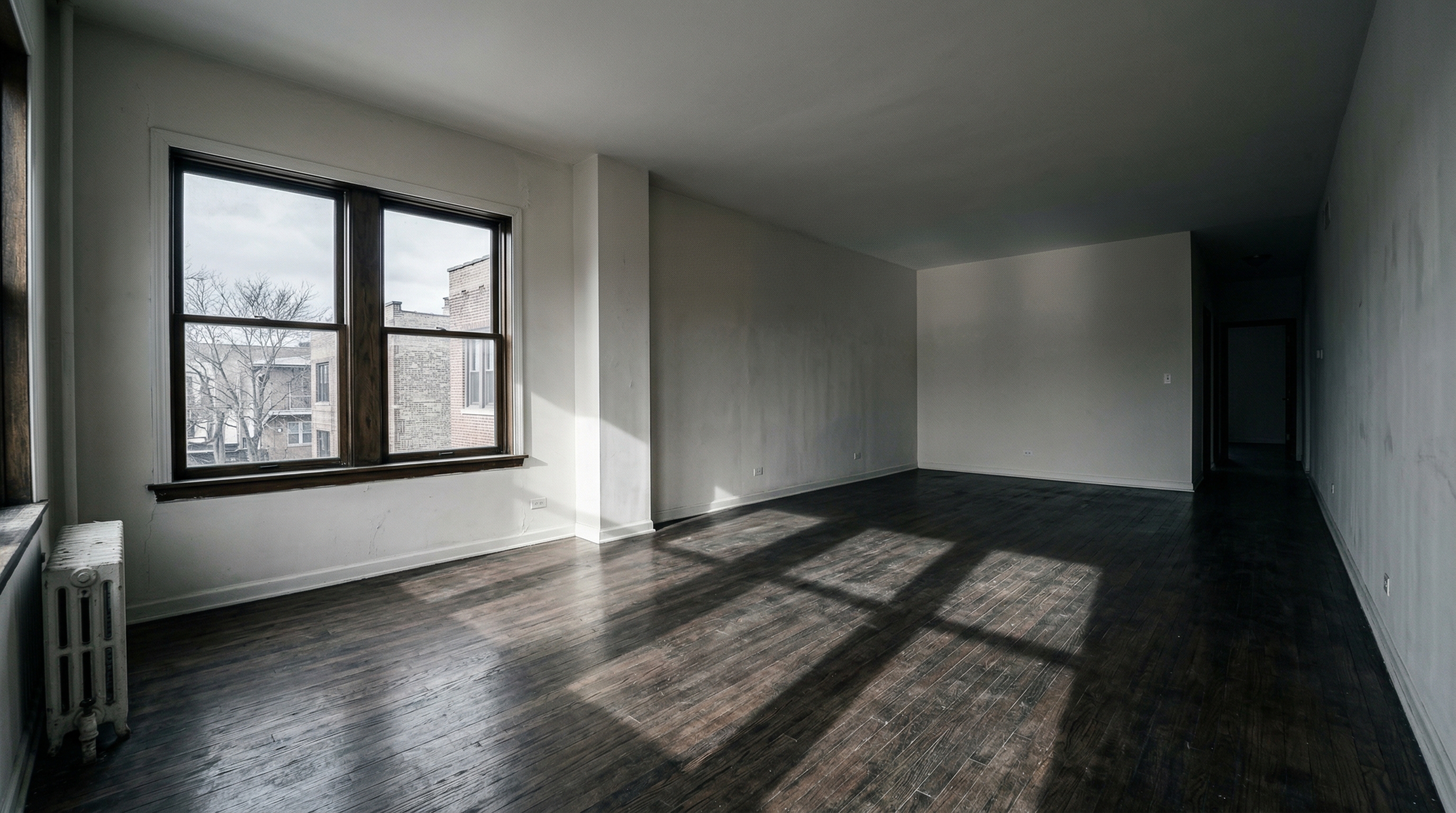
The problem is partly optical and partly psychological. An empty room genuinely appears smaller in photographs than the same room with furniture. This isn't an illusion — it's how human visual perception works. Without reference objects, the brain has no scale markers. A 400-square-foot living room and a 200-square-foot living room look nearly identical when both are empty and photographed from the doorway. Add a full-sized sofa to the 400-square-foot room and suddenly the brain registers the difference.
Empty rooms also suffer from what photographers call "surface fixation." When there's nothing else to look at, the eye is drawn to every imperfection — the scuff mark on the baseboard, the slightly uneven paint edge around the window trim, the dated brass light fixture, the hairline crack in the ceiling. In a staged room, those same imperfections exist but nobody notices them. The sofa, the art, the throw pillows, the coffee table books — they redirect attention from flaws to lifestyle. Your brain shifts from "that wall needs repainting" to "I could see myself reading on that couch on a Sunday morning."
This isn't speculation. It's been studied in the context of retail psychology for decades, and real estate staging leverages the same cognitive mechanisms. The NAR reports that 81% of buyers find it easier to visualize a property as their future home when it's staged, and that visualization is what drives offers.
How much does a vacant listing actually cost per day on market?
Let's do the math on a specific example. Take a $400,000 home with a $320,000 mortgage at 6.5% interest.
Monthly carrying costs: $2,080 mortgage payment, $420 property taxes, $150 insurance, $200 utilities (vacant homes still need climate control to prevent damage), $100 lawn maintenance. That's roughly $2,950 per month, or about $98 per day.
If that home sits vacant for 60 extra days compared to a staged home, the seller burns through $5,880 in carrying costs. That's before factoring in the psychological toll of price reductions — a home that's been on market for 90 days typically sells for 5–10% less than its original list price, according to a 2024 Redfin analysis. On a $400,000 home, that's $20,000–$40,000 in lost value.
Now compare that to the cost of virtual staging: $1 per room for three staged photos. A five-room home costs $5 to stage. Even traditional staging at $3,000–$5,000 is a rational investment against $5,880+ in carrying costs. But virtual staging at $5 total? The ROI calculation is so lopsided it barely qualifies as a decision.
What's the real impact of staging on online listing performance?
97% of buyers start their home search online. That statistic from NAR has been consistent for years, and it means your listing photos are doing more selling than any open house or broker tour. The first photo in your listing carousel has roughly two seconds to convince a buyer to click through to the rest. Two seconds.
An empty room photo competes against a feed full of beautifully staged properties. Every listing looks the same: walls, floor, window. There's nothing to differentiate yours, nothing to stop the scroll on Zillow or Redfin, nothing that makes a buyer's thumb pause and think "tell me more about this one."
The numbers bear this out. Staged listing photos receive 40% more online views than empty room photos, according to a 2024 Real Estate Staging Association study. Properties with staged photos are saved to buyer favorites lists at 2.7x the rate of unstaged listings. And the click-through rate from search results to the full listing page — the single most important metric for online real estate marketing — jumps by roughly 60% when the lead photo shows a staged room versus an empty one.
These aren't marginal improvements. A listing that gets 60% more full-page views generates proportionally more showing requests, which generates more offers, which generates higher prices and faster closes. The entire downstream funnel improves because the top-of-funnel photo was better.
What's the best approach for staging a vacant listing with AI?
Here's the playbook that consistently produces the best results, refined over thousands of listings:
- Photograph every room in the vacant property. Use a wide-angle lens or the wide mode on your phone camera. Stand in the doorway or corner to capture the maximum amount of the room. Shoot during daylight hours when natural light fills the space — avoid flash photography, which creates harsh shadows and blown-out walls. Make sure the room is clean and free of debris, moving boxes, or obvious damage.
- Upload all rooms and select a staging style that matches the property's character and target buyer demographic. Not sure which style to pick? We break down when to use each of the eight staging styles in our detailed guide. As a default, Warm Contemporary works for the broadest range of properties and buyers.
3. Use the staged photos as the primary listing images on MLS, Zillow, Redfin, Realtor.com, and social media. Lead with the living room — it's the most impactful room for first impressions. Follow with the primary bedroom, kitchen (even if minimally staged), and any standout rooms like a home office or sunroom.
4. Include at least one empty room photo alongside the staged versions. This serves two purposes: transparency (buyers know what the actual space looks like) and impact (the contrast between empty and staged makes the staging look even more impressive). Many markets require disclosure of virtual staging, and even where it's not required, including the empty photo builds trust.
5. Consider generating multiple styles for the hero room — usually the living room. A living room staged in Warm Contemporary, Coastal, and Modern Minimalist gives three different buyer personas a reason to engage with the listing. At $1 for three images per style, this costs $3 total and triples your demographic reach.
This entire process — from photographing the property to having finished staged photos ready for MLS — takes less than an hour and costs less than a latte.
Do you have to disclose virtual staging to buyers?
Yes, and you should want to. Disclosure requirements vary by state and MLS, but the trend is unmistakably toward mandatory disclosure. As of 2026, the majority of state Realtor associations either require disclosure of virtual staging in listing photos or strongly recommend it. Most MLS systems have a specific field for indicating that photos have been digitally enhanced or virtually staged.
Beyond the legal requirement, disclosure is good business practice. A buyer who shows up to an empty home expecting the furnished version from the photos isn't going to be pleasantly surprised — they're going to feel misled. That feeling poisons the rest of the showing and often kills the deal entirely. By contrast, a buyer who knows the photos are virtually staged walks into the empty home with the right expectations and uses the staged photos as a reference for how the space could look once they furnish it.
The standard disclosure language most agents use is straightforward: "Photos have been virtually staged to help buyers envision the space. Property is being sold unfurnished." Some agents go further and include a side-by-side comparison of the empty and staged room directly in the listing, which tends to generate positive reactions from buyers who appreciate the transparency.
How does virtual staging compare to leaving a home vacant?
There is no comparison. Every metric favors staging, and the cost of virtual staging has eliminated the only argument against it (price). We covered the full cost and quality breakdown in our comparison of virtual staging vs. traditional staging, but the short version: there is no scenario where leaving a home vacant produces better outcomes than staging it.
The agents and property managers who've internalized this don't treat staging as optional. It's a line item on their listing checklist, right alongside professional photography and MLS data entry. The cost is so low that it doesn't even warrant a conversation with the seller — it's just something you do, like putting a lockbox on the door.
For sellers, especially those paying a mortgage on a vacant property while waiting for offers, the message is simple: every day your listing shows empty rooms is a day you're losing money. The fix takes minutes and costs less than your morning coffee. There is no reason to wait.