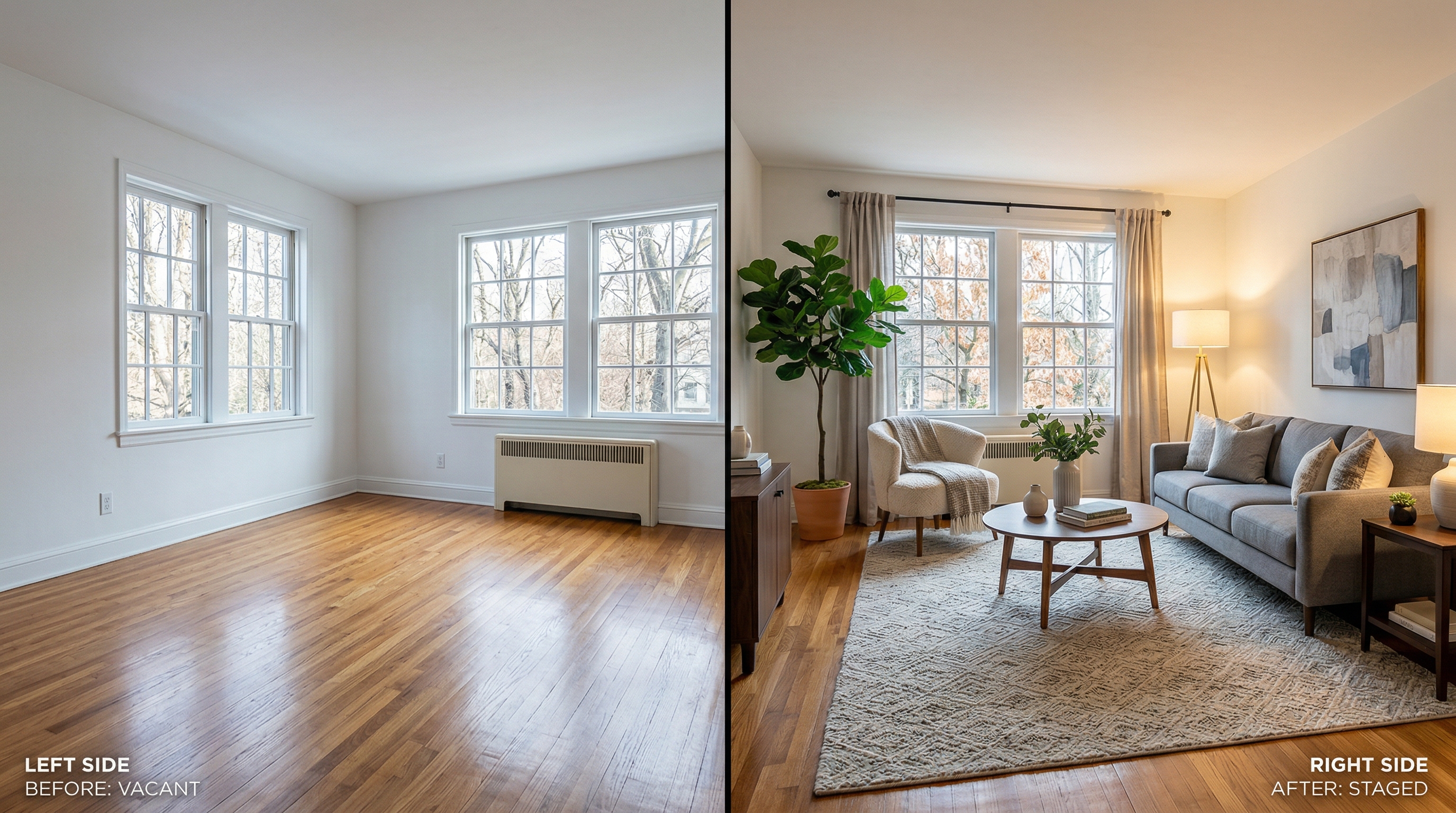
Virtual Staging vs. Traditional Staging: Cost, Speed, and Results Compared
Traditional home staging has been the gold standard in real estate marketing for decades. A professional stager selects furniture, hauls it to the property, arranges it, and a photographer captures the result. The listing goes live, the furniture stays for weeks, and when the property sells, everything gets hauled back out.
It works. Staged homes sell 73% faster and for 5–25% more than vacant properties, according to the National Association of Realtors' 2025 Profile of Home Staging. But the process is expensive, slow, and logistically painful — and there's now a faster option that delivers surprisingly comparable results.
How much does traditional staging cost compared to virtual staging?
Traditional staging runs $2,000–$5,000 for a typical 3-bedroom home. That covers furniture rental, delivery, professional setup, and removal once the home sells. In competitive markets like San Francisco, New York, or Austin, high-end staging regularly exceeds $10,000. You're paying for physical furniture, truck rolls, labor hours, and monthly rental extensions if the property doesn't sell quickly.
The breakdown usually looks something like this: $800–$1,500 for the initial consultation and design plan, $1,000–$2,500 for furniture rental (first month), $200–$500 for delivery and setup, and then $500–$1,000 per additional month. A listing that sits for 90 days can easily rack up $7,000+ in staging costs alone.
Virtual staging flips the economics entirely. Services range from $1 to $30 per room depending on the provider and quality tier. At Stagrr, it's $1 for three staged variations of a single room. Run the math: for the cost of staging one room traditionally, you could virtually stage every room in roughly 2,000 homes. That's not a typo.
For a typical 5-room listing, traditional staging costs $2,000–$5,000. Virtual staging costs $5. The question isn't whether virtual staging is cheaper — it's whether the quality gap justifies a 400x price difference.
How long does each approach take from start to finish?
Traditional staging takes 3–7 business days from initial consultation to photo-ready rooms. You schedule the stager (1–2 days out), wait for furniture availability and delivery (2–4 days), coordinate the setup crew, then book your photographer. If the first style doesn't work or the buyer demographic shifts, you're starting that entire process over.
There's also a scheduling dependency chain that creates fragility. The stager needs to see the property before selecting furniture. The furniture warehouse needs lead time for delivery. The delivery crew needs to match the photographer's schedule. One delay in the chain pushes everything back.
Virtual staging takes under a minute per room. Upload a photo, select a style, and the AI generates three staged variations in about 30 seconds. Don't like the style? Try another one immediately. Want to show the same living room in Warm Contemporary, Coastal, and Modern Minimalist? That takes three minutes and costs $3.
This speed advantage compounds on listings with tight timelines. A property that comes on market Friday needs photos by Monday morning. Traditional staging can't make that happen. Virtual staging can do it from the agent's phone while they're still at the property.
Is virtual staging as realistic as traditional staging photography?
Five years ago, the answer was an unambiguous no. Virtual staging looked fake. Furniture floated above floors, shadows pointed in impossible directions, proportions were cartoonish, and textures had an obvious digital sheen. Nobody was fooling anyone.
That gap has closed dramatically. Modern AI staging models have been trained on millions of interior design photographs, and they understand lighting physics, spatial relationships, material properties, and design principles at a level that produces genuinely photorealistic results. The AI places a sofa that matches the scale of the room, casts shadows consistent with the window placement, and uses textures that respond to the existing light.
In a 2024 blind study by the Real Estate Staging Association, participants correctly identified virtual staging only 38% of the time across a mixed set of traditionally staged and virtually staged photos. That's barely better than a coin flip. For online listing photos — which is where 97% of buyer searches begin, according to NAR — the quality difference has become negligible for most properties.
The one area where traditional staging still holds a clear edge is the in-person experience. When a buyer walks through a beautifully furnished home, they engage more senses — the weight of a real couch cushion, the texture of a rug underfoot. Photos can't replicate that. But for getting buyers through the door in the first place, virtual staging performs just as well.
When should you use traditional staging instead of virtual?
Traditional staging still makes sense in a few specific scenarios. Luxury properties above $1.5 million benefit from physical staging because the buyer expects a curated in-person experience — and because the staging cost represents a smaller percentage of the commission. Open houses where foot traffic matters are another case; there's no substitute for walking into a room that feels lived-in and aspirational.
Properties that will be shown heavily in person — estate homes, model units in new developments, and spec homes in communities with heavy foot traffic — also benefit from the tangible presence of real furniture.
When does virtual staging make more sense?
Virtual staging wins almost everywhere else. Vacant listings are the obvious case — an empty room photographs terribly, and virtual staging fixes that for almost nothing. Rental properties, where landlords won't pay $3,000 for staging but desperately need the unit filled, are another slam dunk. We covered the vacancy cost problem in detail in our post on why vacant homes sit on the market.
New construction where the builder wants to show multiple interior styles without furnishing model units. Investment properties being sold sight-unseen to out-of-state buyers. Price points below $400K where the staging budget is essentially zero. Properties that need to list fast — we're talking same-day turnarounds.
The multi-style advantage is something traditional staging simply can't match. With virtual staging, you can show the same room in three or four different design aesthetics. A young professional sees the Modern Minimalist version and imagines their life there. A family sees the Warm Contemporary version and pictures their kids on that sofa. Check out our breakdown of the eight staging styles that sell homes fastest for the strategy behind style selection.
What do real estate agents actually think about virtual staging in 2026?
The shift has been swift. According to NAR's 2025 survey, 72% of listing agents now use virtual staging on at least some of their listings, up from 31% in 2022. Among agents under 40, that number is 89%. The holdouts tend to be luxury-focused agents who use traditional staging as a differentiator, and agents in markets where in-person showings dominate the buying process.
The consensus among agents who've tried both: virtual staging handles 80% of listings just as well as traditional, at a fraction of the cost and time. The remaining 20% — mostly high-end properties and model homes — still benefit from the real thing.
The bottom line
For most real estate professionals, virtual staging has become the default. The economics are too compelling to ignore. At $1 for three staged images per room, there's no reason to leave a listing vacant when the alternative costs less than a cup of coffee.
The agents who are winning right now are using virtual staging on every listing and reserving traditional staging exclusively for their highest-end properties. That strategy maximizes visual impact across the entire portfolio while keeping marketing costs under control. In a market where margins matter, that's the kind of efficiency that compounds over dozens of listings per year.